Your first sports bet should not begin with the question, “Which match can win me the most money?”
It should begin with a much simpler and much smarter question: “Which match do I actually understand well enough to bet on?”
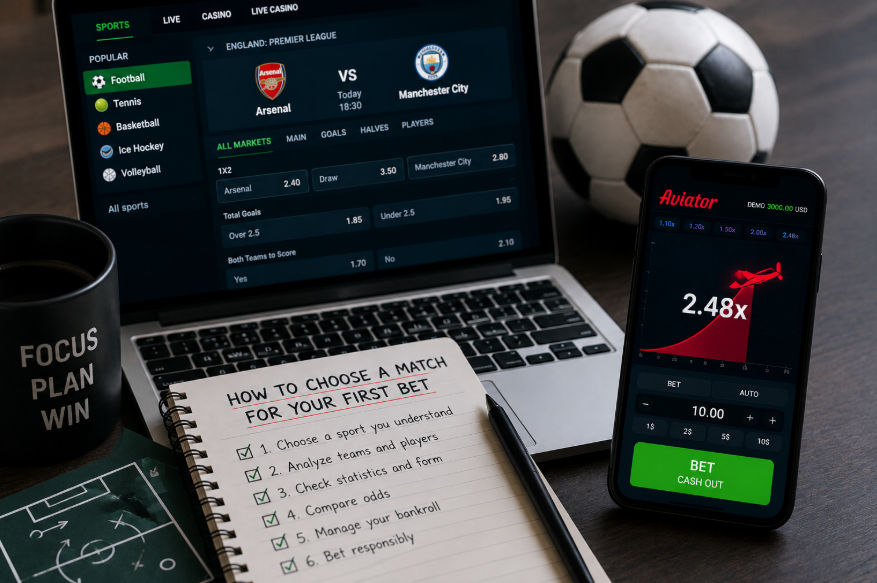
That difference matters. A lot of beginners enter betting with the wrong focus. They look for the biggest game of the day, the most popular team, the highest odds, or the loudest predictions on social media. As a result, their first bet is often based on excitement instead of structure. It feels active, but it is not really thoughtful.
Choosing a match for your first bet is not about finding a guaranteed winner. There is no such thing. It is about reducing unnecessary chaos. A good first match should be clear, readable, and easy to evaluate. It should help you learn how betting works, not throw you into confusion from the first click.
This is especially important now because many beginners move between sports betting and fast-paced products like Aviator without realizing they require very different habits. Aviator is built around speed, timing, and instant decisions. Match betting is different. It works better when you slow down, compare information, and make one calm decision before the event starts. If your goal is to build a strong foundation, your first bet should come from clarity, not adrenaline.
Why the First Match Matters More Than Most Beginners Think
Your first match will not define your entire betting future, but it often shapes your early habits.
If your first bet is placed on a random high-profile game just because it is popular, you may start thinking that betting is mostly about guesswork. If you build your first bet on proper logic, even a losing result can still teach you something useful. That is the key point many beginners miss: a good first bet is not measured only by whether it wins. It is measured by whether the decision made sense.
That is why the match itself matters. Some matches are easy to understand. Others are full of noise, uncertainty, emotional pressure, or too many conflicting factors. A beginner should not be trying to “solve” the messiest event on the board. The first step should be cleaner than that.
The Best First Match Is Usually Not the Biggest Match
Beginners are often drawn to massive games. Famous clubs. Derby matches. Finals. Champions League nights. Title fights. Big tennis names. Huge NBA matchups. It is easy to understand why. These matches are exciting, familiar, and heavily discussed everywhere.
But they are not always the best choice for a first bet.
Big matches often come with too much public attention. The odds are heavily shaped by market demand. Media narratives are everywhere. Emotions are stronger. It becomes harder to separate actual betting logic from hype. A beginner may think they are making a smart pick, but in reality they may just be following the story everyone is already talking about.
A better first match is usually one that feels understandable, not one that feels dramatic.
Start With a Sport You Already Follow
The easiest way to choose a first match is to begin with a sport you already watch regularly.
That may be football, tennis, basketball, hockey, or something else. The important thing is familiarity. You do not need to be an expert. But you should already understand the basic rhythm of the sport:
- what usually decides matches,
- how favorites and underdogs behave,
- what counts as strong or weak form,
- what kinds of situations change momentum.
This matters because if the sport itself feels unfamiliar, every betting decision becomes much harder. You are not just evaluating a match. You are trying to understand the game at the same time.
That is why many beginners do better when they pick their first match from a sport they already enjoy. It reduces confusion and makes the betting side easier to absorb.
Choose a Match You Can Explain in Simple Words
One of the easiest tests for a beginner is this:
Can you explain in two or three simple sentences why this match makes sense for a first bet?
If you cannot explain it clearly, you probably do not understand it well enough yet.
For example:
- Team A is in better form.
- Team B is missing key players.
- This matchup usually produces low-scoring games.
- One player is much stronger on this surface.
- The home side has been consistently better in this spot.
That does not guarantee a winning bet. But it shows that your choice is built on something real.
A weak first match usually sounds like this:
- “I just feel like they will win.”
- “The odds look nice.”
- “Everyone says this is the obvious pick.”
- “It is a big game, so I want action.”
That is not analysis. That is just excitement wearing the clothes of confidence.
Avoid Matches With Too Many Unknowns
A beginner should usually avoid matches where the picture feels cloudy.
That includes situations like:
- uncertain lineups,
- unclear motivation,
- too many injury doubts,
- teams with wildly inconsistent form,
- very low-information leagues,
- matches you have not followed at all,
- events where the betting angle feels forced.
Your first bet should not be built on confusion. It should be built on enough information to form a basic view of the match.
This does not mean you need perfect certainty. That does not exist in betting. But you do need enough clarity to avoid betting blindly.
Team Form Matters, but It Should Not Be Used Lazily
A lot of beginners rely too heavily on recent results. If one team has won several matches in a row, it looks like the obvious side. If another team has lost three straight, it looks like a team to avoid.
Form matters, but it needs context.
Ask:
- Who were those recent results against?
- Did the team actually play well, or just survive?
- Has the level of competition been weak?
- Did they get lucky in those matches?
- Are they now facing a different style of opponent?
The best first match is not just a match where one team has “better form.” It is a match where the form actually helps explain the likely scenario in a meaningful way.
Motivation Is Important, but Beginners Often Overuse It
Motivation is one of the most overused ideas in betting. Beginners often say things like:
- “They need the points more.”
- “This match matters more to them.”
- “They will want it more.”
That can matter, but it should never be your only reason for choosing a match.
Almost every team wants to win. Motivation is only useful when it fits into the larger picture. It works best when it supports other factors like form, squad quality, schedule, or matchup style.
So yes, motivation can help you choose a first match. But if it is the only thing you have, your bet is probably too thin.
Home Advantage Can Help Simplify the Picture
For a first bet, home advantage can be one of the easiest useful factors to understand.
Many teams perform more confidently at home. Travel matters. Crowd energy matters. Familiarity matters. Some clubs are clearly stronger in their own stadiums, while others struggle away from home.
This does not mean home teams are always the better bet. But if you are choosing between several possible first matches, a game where home advantage clearly matters may be easier to read than one where both sides are equally unpredictable.
Start With Simple Markets, Not Complicated Ones
Choosing the right match is only half the job. The market matters too.
For your first bet, it is usually better to choose a match that allows for a simple market, such as:
- match winner,
- double chance,
- over/under goals or points,
- both teams to score.
These markets are easier to understand and easier to review afterward.
A common beginner mistake is choosing a match and then forcing a complicated market just to feel smarter. That usually creates more confusion, not more value.
Your first bet should teach you how betting decisions work. Simpler markets do that better.
Why a Calm Pre-Match Is Better Than a Live Match for Beginners
Your first match should usually be a pre-match bet, not a live bet.
Live betting may look more exciting, but it is much harder for a beginner to handle properly. Odds move fast. Emotions spike quickly. One attack, one goal, one break point, one run of play — and suddenly the urge to react becomes overwhelming.
For a first bet, that is not helpful.
A pre-match selection gives you time to think. You can compare information, read the market, and make a decision without pressure. That is exactly what a beginner needs.
This is also where the contrast with Aviator becomes very important. Aviator rewards fast reaction and quick risk-taking. Sports betting, especially your first match bet, should reward patience. If you treat your first sports wager like a fast game, you will probably make the wrong kind of decision.
Do Not Pick a Match Just Because You Want Action
This is one of the hardest lessons for beginners, but one of the most valuable.
Sometimes you open the board, scroll through matches, and realize there is nothing that feels clearly worth betting on. That is normal.
You do not need to force a first bet just to get started. In fact, refusing a weak first match is often smarter than placing a random one just to feel involved.
The best first match is one that makes sense. If the logic is not there, waiting is better than acting.
A Good First Match Usually Has These Features
If you want a simple checklist, your first match is usually a good candidate when:
- it is in a sport you already understand,
- you know the basic context,
- lineups or player conditions are mostly clear,
- the betting market is simple,
- your reason for choosing it is easy to explain,
- the match does not feel overloaded with noise or hype,
- you are not choosing it just because you are bored.
That is a much stronger foundation than trying to force yourself into the most glamorous event available.
What About Aviator?
Since you asked to include Aviator, it is worth addressing directly.
Aviator is often visible alongside sports betting products on modern betting platforms, and beginners sometimes move between the two very casually. But they should not think about them the same way.
A sports match can be analyzed:
- form,
- injuries,
- style,
- schedule,
- motivation,
- odds movement.
Aviator does not work like that. It is not a match. It is not a sport. It does not reward patient event analysis in the same way. It is much faster, much more reactive, and much easier to approach impulsively.
That is why a beginner who wants to learn sports betting properly should keep these two things mentally separate. If your goal is to place a first sports bet with clear logic, focus on the match, not on fast-paced gaming habits.